The War of the Worlds
H.G. Wells' 'The War of the Worlds' is a foundational science fiction text that uses a terrifying Martian invasion to ruthlessly critique Victorian imperialism, human arrogance, and the fragility of civilisation. It is a highly rewarding text for IGCSE Literature because its precise, scientific language and complex narrative structure offer abundant opportunities for high-level AO2 analysis.
Study Notes
Overview
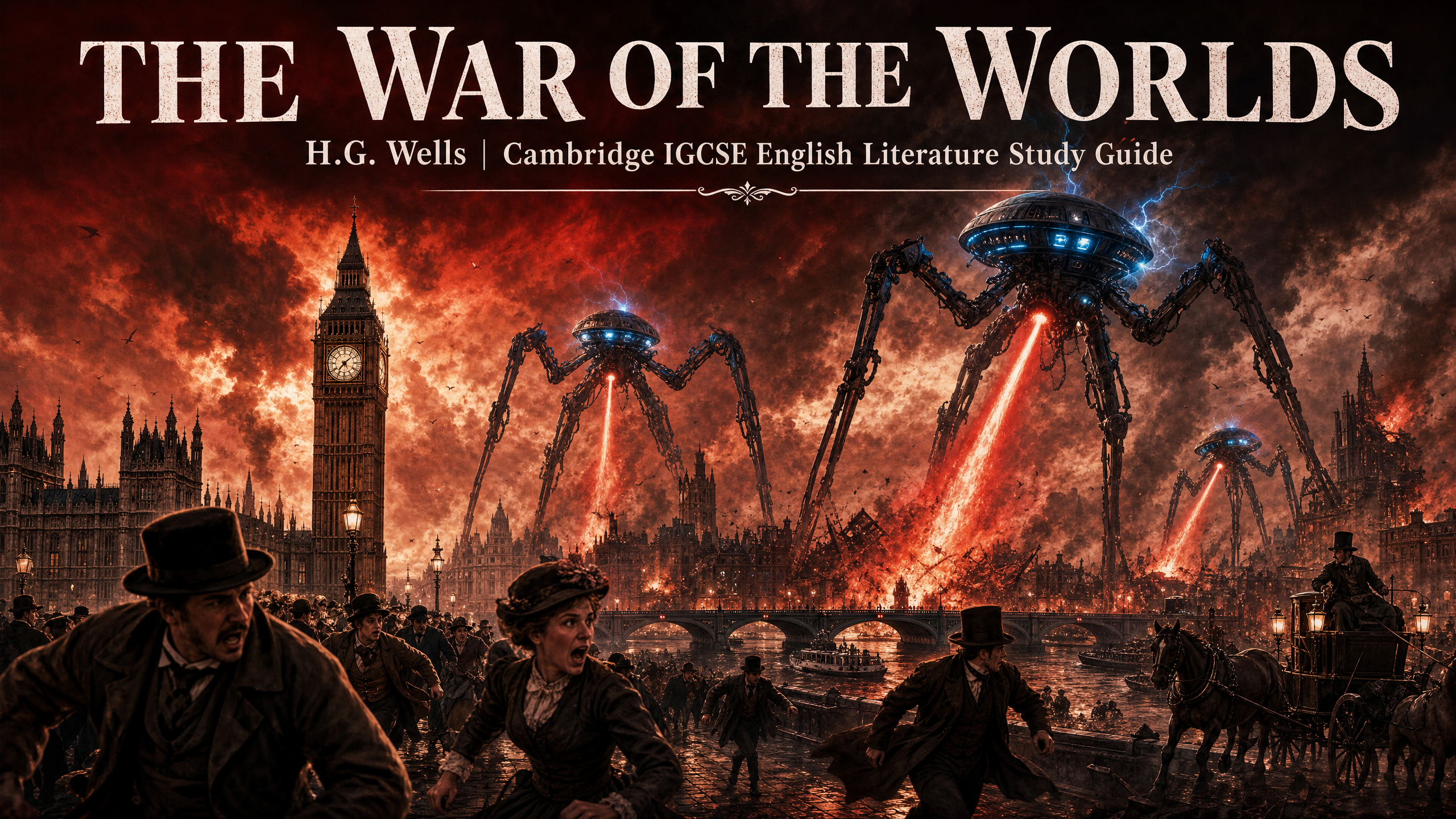
'The War of the Worlds' (1898) by H.G. Wells is far more than a simple tale of alien invasion. It is a profound, allegorical critique of late-Victorian society, specifically targeting British imperialism, scientific hubris, and the complacency of a civilisation that believed itself to be the pinnacle of evolution. For Cambridge IGCSE English Literature candidates, the key to success lies in understanding that Wells is using the Martians as a mirror. By subjecting the British to the same devastating conquest they inflicted upon indigenous populations worldwide, Wells forces his readers to confront the moral realities of empire. Examiners will reward candidates who can consistently link the novel's thrilling events to Wells' deeper social commentary, demonstrating a nuanced grasp of how context (AO3) shapes the narrative.
Listen to the companion podcast for this guide:
Plot/Content Overview
Book I: The Coming of the MartiansThe novel opens with the narrator in Woking, Surrey, observing the arrival of cylindrical objects from Mars. The local population's initial curiosity quickly turns to terror as the Martians emerge and deploy devastating weapons: the Heat-Ray and the Black Smoke. The British military is rapidly overwhelmed. As the Martians march towards London in towering tripod machines, society collapses. The narrator flees, becoming separated from his wife, and witnesses the "rout of civilisation" as millions of desperate refugees clog the roads out of the capital.
Book II: The Earth Under the MartiansThe narrative shifts to a more psychological focus. The narrator is trapped in a ruined house with a Curate, whose religious faith shatters under the trauma, leading to his madness and death. Later, the narrator encounters an Artilleryman who outlines a grandiose but ultimately hollow plan for human survival underground. Eventually, the narrator discovers that the Martians have died, not from human weapons, but from Earth's bacteria, to which they had no immunity. He is reunited with his wife, but the psychological scars of the invasion remain.
Themes
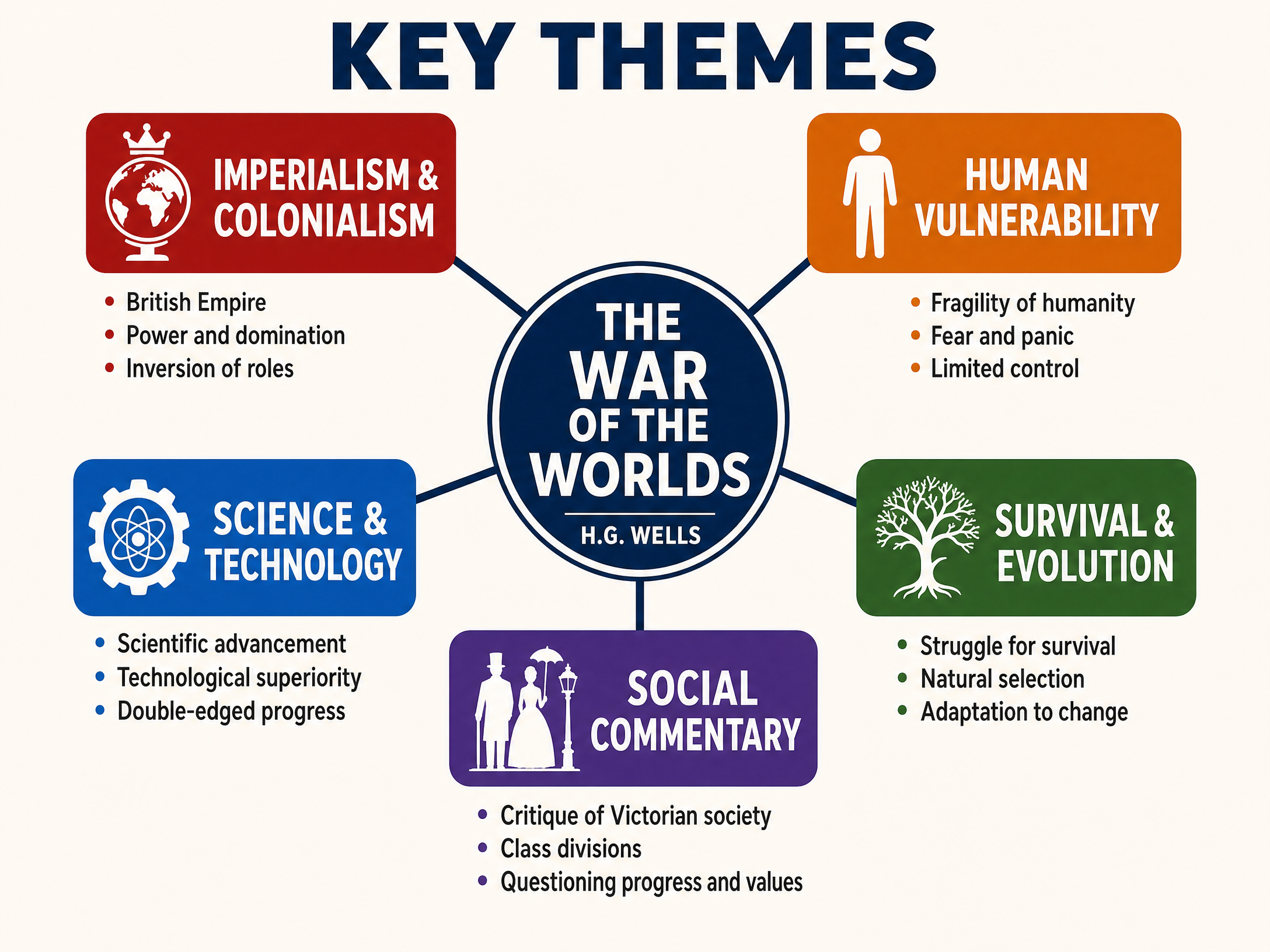
Theme 1: Imperialism & Colonialism
Wells explicitly uses the Martian invasion to invert the British imperial experience. At the height of the British Empire, the Victorians saw themselves as the ultimate colonisers. By making them the colonised, Wells forces a reckoning with the brutality of imperial conquest. The Martians' superior technology and ruthless extermination of humans directly parallel European actions in places like Tasmania.
Key Quotes:
- "Before we judge of them too harshly we must remember what ruthless and utter destruction our own species has wrought... Are we such apostles of mercy as to complain if the Martians warred in the same spirit?" (Book 1, Chapter 1) - Wells explicitly connects Martian aggression to human imperialism, demanding moral self-reflection from the reader.
- "They were swept out of existence in a single span of fifty years." (Book 1, Chapter 1) - Reference to the Tasmanians, establishing the historical context of colonial violence.
Theme 2: Human Vulnerability and the Fragility of Civilisation
Wells dismantles the Victorian myth of human supremacy and unshakeable progress. The rapid collapse of London's infrastructure, government, and social order demonstrates that civilisation is merely a thin veneer over primal survival instincts.
Key Quotes:
- "It was the beginning of the rout of civilisation, of the massacre of mankind." (Book 1, Chapter 17) - The noun 'rout' implies a chaotic, humiliating defeat, emphasising the complete failure of human societal structures.
- "We are just ants... just ants." (Book 2, Chapter 7) - The Artilleryman's zoomorphic metaphor highlights humanity's sudden reduction to insignificance and powerlessness in the face of a superior force.
Theme 3: Science, Religion, and Evolution
Influenced heavily by Darwinism, Wells explores the conflict between scientific rationalism and religious faith. The Martians represent a possible evolutionary future for humanity—pure intellect devoid of emotion or physical frailty. Meanwhile, traditional religion, embodied by the Curate, is shown to be entirely inadequate in explaining or coping with the new reality.
Key Quotes:
- "Intellects vast and cool and unsympathetic." (Book 1, Chapter 1) - The adjectives 'cool' and 'unsympathetic' characterise the Martians as terrifyingly rational and devoid of human empathy, representing the dark side of pure scientific evolution.
- "Why are these things permitted? What sins have we done?" (Book 1, Chapter 13) - The Curate's desperate questioning reveals the collapse of his theological worldview when confronted with arbitrary destruction.
Character Analysis
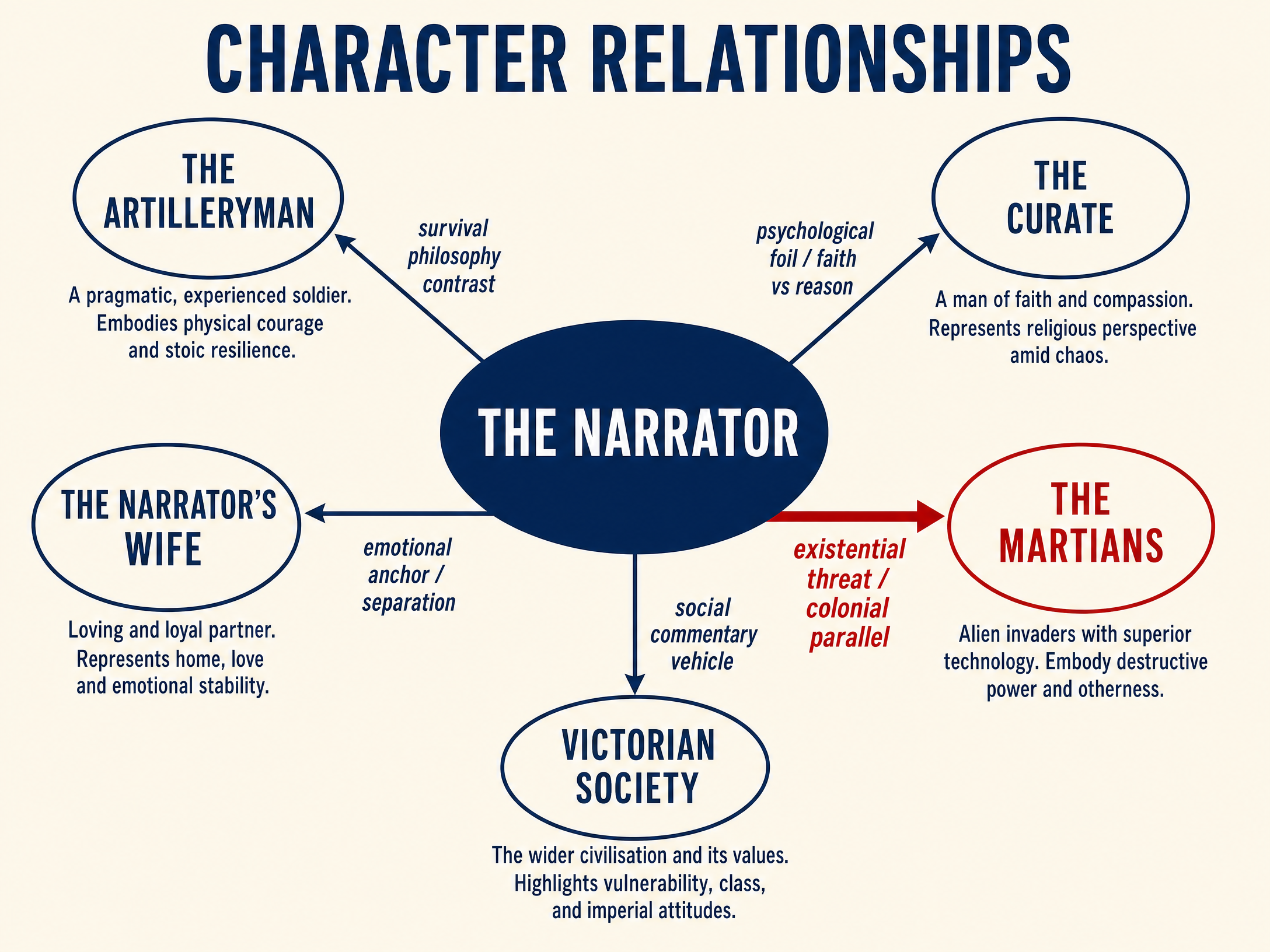
The Narrator
Role: The lens through which the reader experiences the invasion; an everyman figure representing educated Victorian society.
Key Traits: Observant, rational, increasingly traumatised, resilient.
Character Arc: Moves from comfortable scientific detachment and complacency to desperate, animalistic survival, and finally to a state of profound philosophical humility.
Essential Quotes:
- "No one would have believed in the last years of the nineteenth century that this world was being watched keenly and closely by intelligences greater than man's."
- "I felt the first inkling of a thing that presently grew quite clear in my mind, that oppressed me for many days, a sense of dethronement, a persuasion that I was no longer a master, but an animal among the animals."
The Curate
Role: A symbol of the failure of orthodox religion in the face of existential catastrophe.
Key Traits: Weak, hysterical, dogmatic, unable to adapt.
Character Arc: Regresses from a respected community figure to a babbling, dangerous liability whose inability to remain quiet threatens the narrator's survival.
Essential Quotes:
- "This must be the beginning of the end... The end! The great and terrible day of the Lord!"
- "He was as lacking in restraint as a silly woman. He would weep for hours together."
The Artilleryman
Role: Represents the military response and a pragmatic, though ultimately flawed, vision of survival.
Key Traits: Practical, visionary, lazy, self-deluding.
Character Arc: Initially appears as a tough survivor with grand plans to rebuild society underground, but is exposed as a fantasist who prefers drinking and playing cards to actual labour.
Essential Quotes:
- "It's all over... They've lost one—just one. And they've made their footing good and crippled the greatest power in the world."
- "Life is real again... The useless and cumbersome and mischievous have to die. They ought to die."
Writer's Methods
First-Person Retrospective Narrative: The use of an unnamed, retrospective narrator creates both intimacy and dramatic irony. We experience the terror firsthand, yet the past-tense delivery constantly reminds us that the narrator survived, allowing Wells to focus the reader's attention on how and why events unfold rather than just what happens.
Scientific and Journalistic Register: Wells employs a dry, factual, almost documentary style of prose. This realism grounds the fantastical elements of the story, making the horror more visceral and believable. The use of precise geographical locations (Woking, Weybridge, London) heightens this effect.
Zoomorphism and Dehumanisation: Wells repeatedly describes humans using animal imagery (ants, rabbits, dodos, frogs) to emphasise their sudden loss of apex predator status. This linguistic technique effectively conveys the thematic shift in power dynamics.
Sensory Imagery: The novel is rich in terrifying sensory details, particularly the contrast between the mechanical, metallic sounds of the Martians and the chaotic, organic noises of fleeing humanity, as well as the striking visual contrast of the Black Smoke and the red Heat-Ray against the familiar English landscape.
Context
The British Empire: In 1898, Britain was the world's dominant superpower. Wells' novel is a direct challenge to the jingoism and complacency of the era, asking the British to imagine themselves as the victims of colonial expansion.
Darwinism and Evolution: Charles Darwin's On the Origin of Species (1859) profoundly influenced Wells. The novel explores natural selection, survival of the fittest, and the terrifying possibility that humanity might not be the endpoint of evolution. The ending—where bacteria defeat the Martians—is a masterclass in applying Darwinian logic.
Fin de Siècle Anxiety: The end of the 19th century was marked by both rapid technological advancement and a deep anxiety about the future, the decay of society, and the potential for apocalyptic conflict. The novel taps directly into these fears.
Worked Examples
2 detailed examples with solutions and examiner commentary
Practice Questions
Test your understanding — click to reveal model answers
How does Wells create a sense of terror and panic in his description of the Martian attacks? (30 marks)
Hint: Focus on the sensory imagery (sound and colour), the dehumanisation of the crowds, and the sheer destructive power of the Heat-Ray.
Explore the significance of the Artilleryman in the novel. (30 marks)
Hint: Consider what he represents initially (military resistance) versus what he becomes (delusional survivalist). How does he contrast with the Curate?
How does Wells present the theme of science and technology in the novel? (30 marks)
Hint: Look at the contrast between human technology (which fails) and Martian technology. Consider how science is presented as both a tool for understanding and a weapon of destruction.
Explore how Wells uses settings to reflect the collapse of society. (30 marks)
Hint: Track the movement from the peaceful suburbs (Woking) to the chaotic roads, to the ruined metropolis of London, to the claustrophobic ruined house.